In April, I decided to find out whether AI could be more than a casual tool for me. I subscribed to Claude Pro and started projects… many projects. I began catching up with C++20 through a small game, built a hands-on coroutines course with Claude as my tutor, and planned games I had always wanted to make. Then the WoW Forever beta arrived. I asked Claude, “How hard is it to write a WoW addon?” Two weeks later I had a working one. I had never felt so empowered to build anything.
Then came the reality check. Looking back, I saw a lot of projects I had started and abandoned.
A line from a conversation with Claude struck me: with AI, starting costs almost nothing, and that is the trap in “everything feels possible”. Abandoning costs nothing either, so nothing forces a decision. It is easy to beat ourselves up at moments like this, so I decided to test my assumptions against data: about 400 commits across eight projects between April and October 2026, built with AI assistance and a spec-driven workflow I also built. The findings surprised me.
Finding 1: most projects weren’t abandoned, they were closed. My C++20 course ends with a commit literally called “Course Completed!”. Flatline ends with “plan complete” and “spec Implemented”. What faded was my appetite for the next spec, not my drive to keep working.
Finding 2: the relay. A new project often started the day the previous one ended. Flatline’s last commit and Quartermaster’s first are on the same day, August 9. Sometimes a new project grew out of friction in the old ones: I was copying skills from project to project, so Kitbash became a Claude Code plugin that packages them. Sometimes excitement took over: Lodestar, my WoW addon, took all the air (and time) away from a game project. That game’s last commit and Lodestar’s first are both on October 12. And sometimes a project forced me to pause another: my Pac-Man game stopped while I built the coroutines course, because I realized I hadn’t properly grasped how coroutines could replace the classic state machine. The course’s last commit is on May 17, and the Pac-Man work resumes on May 18.
Finding 3: bursts. Flatline had 52 commits in its first two weeks, then a much calmer pace. This matches my spec-driven discipline: I start every piece of work by writing a SPEC and a PLAN, small or large. The PLAN creates a clear target, and AI keeps me focused on following it from beginning to end. Lodestar looks different. I am its user, and two thirds of its commits (48 of 72) come between 10 pm and 2 am, in my free time. In its first two weeks, we reached almost every milestone planned for the beta. It is still young, though, so the real test is ahead.
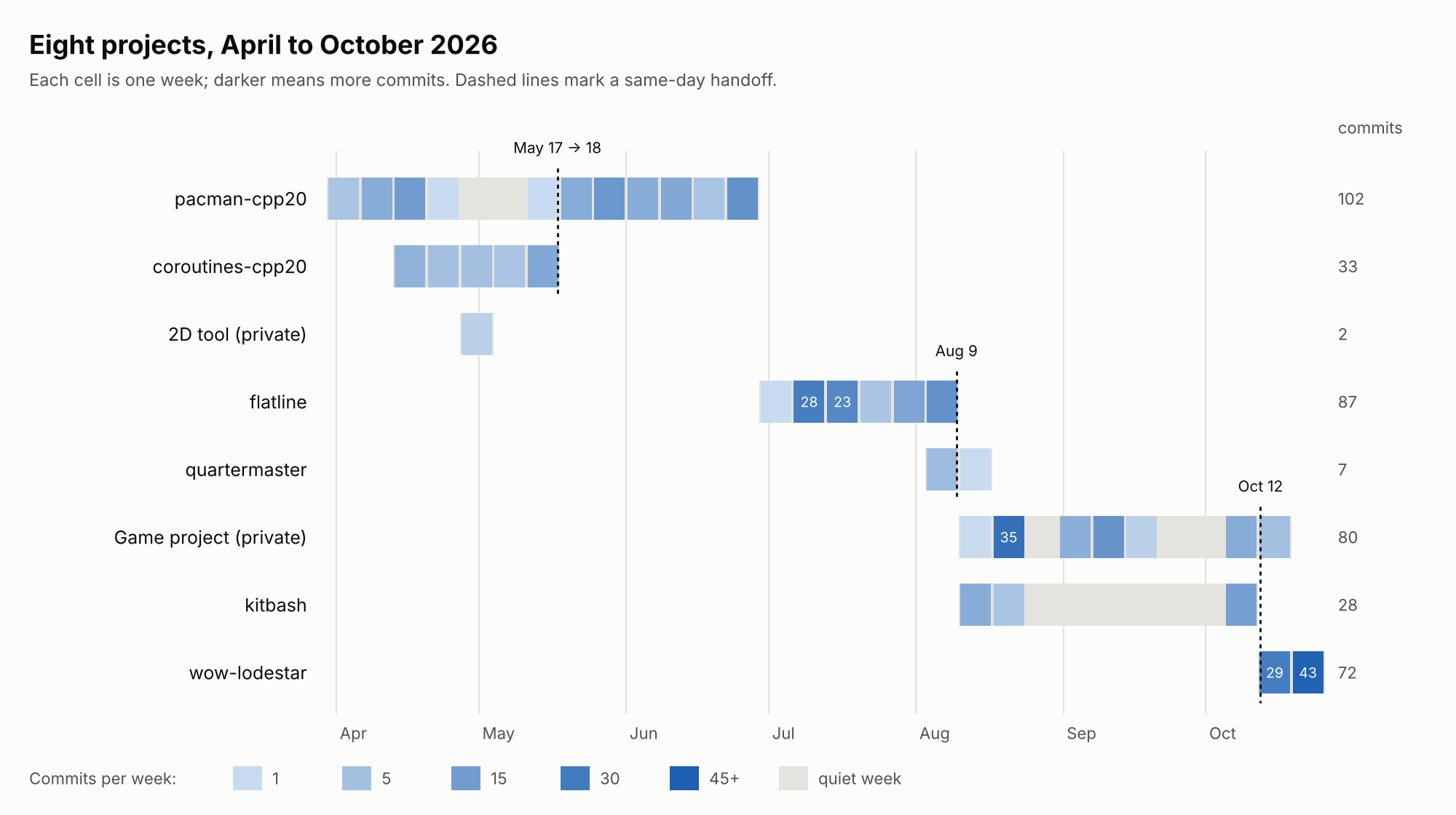 Weekly commits per project, April to October 2026.
What I learned
1. Parking a project on purpose is not the same as leaving it unfinished. The journey can be worth more than the goal you started with, but only if you keep track of what you learned. So I now write a short note for every project I park: what I built, what I learned, and what would make me resume.
2. One active project and one maintenance project. Starting is nearly free, so discipline is what gives each small effort its value.
3. Ask the question at “Implemented”. When I reach that step, I will ask: “Next SPEC, or park?” If I park, I write down why.
If you sometimes feel, like me, that you don’t progress or that you leave things behind, look at your own GitHub history with a short command like this one:
git log --format=%ad --date=short | sort | uniq -c
Then reflect on what you see, without judgment. It may surprise you.